Mutant Corporation — Orbital Data SovereigntyFounded 2026 · Est. horizon 100–1,000 yrs

01 — The Proposition

The stars are waiting.
We are making sure
they remember us.

For millennia, human history has been written on fragile mediums. Mutant Corporation is building the largest interstellar storage network in human history — so that wherever humanity goes, its memory goes too.

Tiers
03
Archive horizon
1,000 yr
Sections in dossier
35
Origins

Enter Mutant Corporation

Founded
2026
Horizon
100–1,000 years
Ambition
Interstellar

For millennia, human history has been written on fragile mediums. From the papyrus scrolls of ancient Egypt to the decaying magnetic tapes of the early digital age, our greatest achievements, art, scientific breakthroughs, and cultural milestones have always been vulnerable to fire, flood, war, and the slow erosion of time.

Even today, as we store petabytes of data in sprawling server farms across Earth, our digital footprint remains tethered to a single, fragile pale blue dot.

Founded in 2026, Mutant Corporation began with a radical, almost audacious premise: what if human knowledge didn't just survive on Earth, but lived above it?

What started as a vision for orbital data sovereignty has rapidly evolved into a grand, multi-century blueprint. Over the next 100 to 1,000 years, Mutant Corporation is embarking on the most ambitious engineering feat in human history — building the largest interstellar storage network spanning star systems and planetary installations.

The Vision

Why Interstellar Storage?

As humanity reaches for the stars — establishing permanent colonies on the Moon, terraforming Mars, and eventually launching generation ships toward neighboring star systems — a fundamental problem arises.

The Tyranny of Distance

Light-years of empty space make real-time communication impossible. If a colony in the Alpha Centauri system needs access to historical archives, scientific formulas, or cultural records, waiting years for a data packet from Earth is not a viable option.

Never One Cosmic Basket

Relying on a single planetary home for the sum of human knowledge violates the cardinal rule of data redundancy: never keep all your eggs in one cosmic basket. Human memory must not depend on one world surviving.

Mutant Corporation's interstellar storage network solves both problems by decentralizing human memory. By embedding high-density, radiation-hardened data nodes across multiple planetary bodies, Lagrange points, and deep-space relays, Mutant Corporation is ensuring that wherever humanity goes, its history goes too.

The Roadmap

From Earth-Orbit to the Stars

Realizing a network that spans centuries and star systems requires a phased, generational approach — bridging the gap between our current technological infancy and a truly Kardashev-scale future.

01
Phase 1

Orbital Sanctuary

The 2030s – 2100s

Moving beyond terrestrial vulnerabilities, Mutant Corporation is deploying low-Earth and geostationary orbital data vaults. Shielded from electromagnetic interference and natural disasters on Earth, these platforms serve as the first line of defense for critical planetary archives.

02
Phase 2

Planetary Expansion

22nd – 24th Centuries

As humanity expands across the solar system, Mutant Corporation will establish deep-crust data vaults on the Moon, Mars, Europa, and the outer moons. These installations will utilize extreme-environment storage mediums — such as fused quartz glass matrices capable of surviving millennia — powered by geothermal and fusion energy.

03
Phase 3

The Interstellar Bridge

25th Century and Beyond

The ultimate frontier. Utilizing high-speed quantum entanglement relays (where feasible) and automated courier probes, Mutant Corporation will begin linking our solar system to the first interstellar colonies, creating a seamless, decentralized web of human thought spanning light-years.

Engineering

Engineering the Indestructible

How do you build a storage network designed to last a millennium and function across the harsh vacuum of space? Traditional hard drives and flash memory simply will not suffice.

5D Quartz Nanostructures

By engraving data into five-dimensional quartz nanostructures using ultrafast laser pulses, information can withstand extreme heat, cosmic radiation, and magnetic fields without degradation. A single coin-sized quartz disc can hold hundreds of gigabytes of data and remain stable for billions of years.

Self-Healing AI Architectures

Our vaults are designed to maintain themselves — continuously verifying their own integrity, detecting degradation at the molecular level, and repairing or re-replicating data before loss can occur across generational timescales.

Redundant Mesh Networking

Redundant mesh networking protocols let every node adapt to the shifting technological paradigms of future human generations, routing around failed relays and preserving continuity across light-years of distance.

5D
Optical data encoding
10⁹
Years of media stability
100s
Gigabytes per quartz disc
A Promise to the Future

We are living in a unique epoch of human history — the cusp of our transition from a single-planet species to an interstellar civilization.

The choices we make today regarding how we preserve our culture will echo for millennia. Will our descendants venture into the dark expanses of the galaxy armed with the full tapestry of human knowledge, art, and science? Or will they start from scratch, having lost the lessons of the past to cosmic amnesia?

At Mutant Corporation, the answer is clear. Founded in 2026 with a bold ambition and scaling toward a millennium-long destiny, we are committed to a singular, unifying purpose:

To make every byte of humanity's knowledge indestructible, accessible, and instantaneously available across the stars.

Dossier — 35 sections

Beyond the Cradle

Mutant Corporation and the quest for an interstellar digital archive — the full argument, from papyrus to the outer reaches, in thirty-five parts.

Seven parts35 sectionsHorizon 100–1,000 years
Part I — The Fragility of Memory
01
Prologue

Papyrus, Parchment, Tape

Every archive is a promise made to people who have not been born yet. History is largely the record of how often that promise has been broken.

Egyptian papyrus endured three thousand years only where the air was dry enough to refuse decay. Medieval scribes copied by candlelight, losing a word here and a line there, until the text they carried forward was a distant cousin of the original. Magnetic tape, the miracle medium of the twentieth century, began shedding its own recordings within decades — sometimes inside the very vaults built to protect it.

Each era believed its storage was permanent, because permanence is invisible from the inside. A medium always looks durable until the day it fails. The archive does not warn you that it is dying; it simply stops answering.

We have never lost our memory all at once. We lose it in whispers, one format at a time.
Mutant Corporation — Archive Doctrine
02
The Record of Loss

The Silent Losses

Catastrophe makes the news. Attrition does not, and attrition is responsible for the overwhelming majority of what humanity has forgotten.

We have lost languages that were never written down, films whose nitrate stock ignited in a projection booth, census records abandoned when an institution lost funding, and entire scientific programs whose only copies lived on a single drive. The Library of Alexandria is the famous example, but it is the least instructive one, because it was singular. The ordinary losses were distributed, unremarkable, and cumulative.

The pattern repeats with mechanical reliability: the more a civilization depends on a medium, the more catastrophic that medium's quiet failure becomes. There is no monument for a broken format, and no ceremony for a decade of records that can no longer be parsed.

Decades

before consumer magnetic media begins to degrade

One copy

is how most institutional knowledge has survived

Zero

global archives engineered for a non-terrestrial future

03
The Modern Paradox

The Server Farm Paradox

Vast server farms hold petabytes of human information, anchoring civilization in a sea of data. Yet all of it remains concentrated on one vulnerable world.

Contemporary cloud infrastructure is genuinely remarkable. Replication across continents, erasure coding, cryptographic integrity, automatic failover — the engineering is mature and the redundancy is real. But all of that redundancy shares a single atmosphere, a single magnetosphere, a single set of assumptions about power grids, supply chains and political stability.

Replication protects against a failed drive. It does not protect against a failed planet. We have built a system with extraordinary depth of protection and almost no breadth, and we have mistaken depth for safety.

At a glance

Regional replication
Protects against hardware, weather and operator error within one planetary system.
Shared vulnerability
Solar storms, atmospheric events and grid collapse affect every region simultaneously in kind, if not in degree.
Concentration
A small number of hyperscale facilities now hold a disproportionate share of the written world.
04
Risk

A Single World, a Single Point of Failure

A planetary-scale cataclysm — natural or human-made — could erase centuries of accumulated knowledge in an instant, and no terrestrial backup plan can survive it.

The hazards are not speculative. Coronal mass ejections have already demonstrated the capacity to disturb power distribution at continental scale. Impact events are rare but statistically inevitable. Human-made risks — conflict, cascading infrastructure failure, deliberate attack on information systems — are faster moving and considerably more probable.

The uncomfortable truth is that no amount of Earth-based redundancy converts a single-planet system into a resilient one. Resilience at planetary scale requires a second planet, or at minimum a second orbit.

You cannot back up a planet to itself.
Mutant Corporation — Archive Doctrine
Part II — The Founding
05
2026

The Divergent Question

Mutant Corporation was founded in 2026 around a question that the industry had learned to stop asking: could humanity's knowledge be safeguarded not only on Earth, but beyond it?

The question was not new. It had been asked in essays, in science fiction, in the margins of aerospace papers for half a century. What had not been attempted was the unglamorous part — treating it as an engineering program with a schedule, a bill of materials, and a doctrine rather than a thought experiment.

The founding team came out of storage architecture, orbital systems and long-horizon infrastructure finance, and shared a specific frustration: every conversation about digital preservation ended at the boundary of the atmosphere. Mutant was started at that boundary.

At a glance

Founded
2026, as an orbital data infrastructure venture.
Discipline
Storage engineering, aerospace systems, and multi-generational capital planning.
Premise
That digital preservation is a civilizational responsibility, not a product category.
06
The Concept

Orbital Data Sovereignty

The first articulation of the company's purpose was a single idea: information should be sovereign over its location, not hostage to it.

Orbital data sovereignty treats the placement of an archive as a strategic decision rather than a cost decision. It asks where information must live in order to remain intact, and then works backward to the infrastructure required. For the most important data, the answer cannot be a building.

What began as a visionary concept has since widened into a multi-generational blueprint for preserving information across the cosmos — an architecture in which orbit is the first step rather than the destination.

Sovereignty over your own record means never depending on a single sky.
Mutant Corporation — Archive Doctrine
07
Scale

From Venture to Civilizational Project

Mutant Corporation is no longer only a technology venture. It is a centuries-long engineering ambition with a delivery plan measured in institutions rather than funding rounds.

A company that intends to operate for a hundred years must be designed differently from one that intends to exit in seven. That changes the capital structure, the hiring, the way risk is documented, and the way promises are made. It also changes what counts as success: not quarterly growth, but the survival of the archive through the lives of its founders.

The program is structured as a sequence of increments, each independently valuable and each one a prerequisite for the next. Orbital vaults are not a demonstration of ambition; they are the load-bearing first floor of a structure that is meant to hold weight for a very long time.

At a glance

Increment one
Radiation-tolerant media validated in orbital conditions.
Increment two
Self-maintaining archive nodes with autonomous custodianship.
Increment three
Distributed replication across multiple celestial bodies.
08
Doctrine

The Mutant Doctrine

Six principles govern every engineering decision the company makes, and each of them is a constraint rather than an aspiration.

Doctrine exists to settle arguments before the argument becomes expensive. When a trade-off arrives — mass against redundancy, throughput against longevity, autonomy against control — the doctrine decides, and the decision is recorded so that successors can audit it.

The principles are deliberately conservative. They assume that people will make mistakes, that institutions will change, and that the archive will one day need to be understood by someone who was not present at its design.

At a glance

I. Assume loss
Design every system for the failure of its own assumptions.
II. Distance is protection
Separation in space is the only durable form of redundancy.
III. Legibility outlives technology
A format no future reader can parse is not preservation.
IV. Autonomy over supervision
Systems must survive the absence of their operators.
V. Publish the method
A preservation architecture must be inspectable to be trusted.
VI. Stewardship, not ownership
The archive belongs to those who inherit it.
Part III — The Architecture of Eternity
09
Master Plan

Three Tiers of Permanence

The company's master plan is to develop a decentralized storage network spanning orbital infrastructure, rugged planetary installations, and ultimately multiple star systems.

Each tier answers a different class of failure. Orbital vaults answer planetary catastrophe. Planetary installations on other bodies answer orbital perturbation, institutional collapse and the slow decay of ground support. Interstellar placement answers the longest class of all — the evolution of the star the archive was built around.

The tiers are cumulative rather than alternative. No single tier is described as sufficient, and the architecture is judged on whether it remains coherent if any one of its layers is removed.

At a glance

Tier I — Orbit
Continuous, low-latency access with separation from terrestrial risk.
Tier II — Other worlds
Rugged, autonomously maintained archives under different physical conditions.
Tier III — Interstellar
Deep-time replicas designed for transport across generations.
10
Tier I

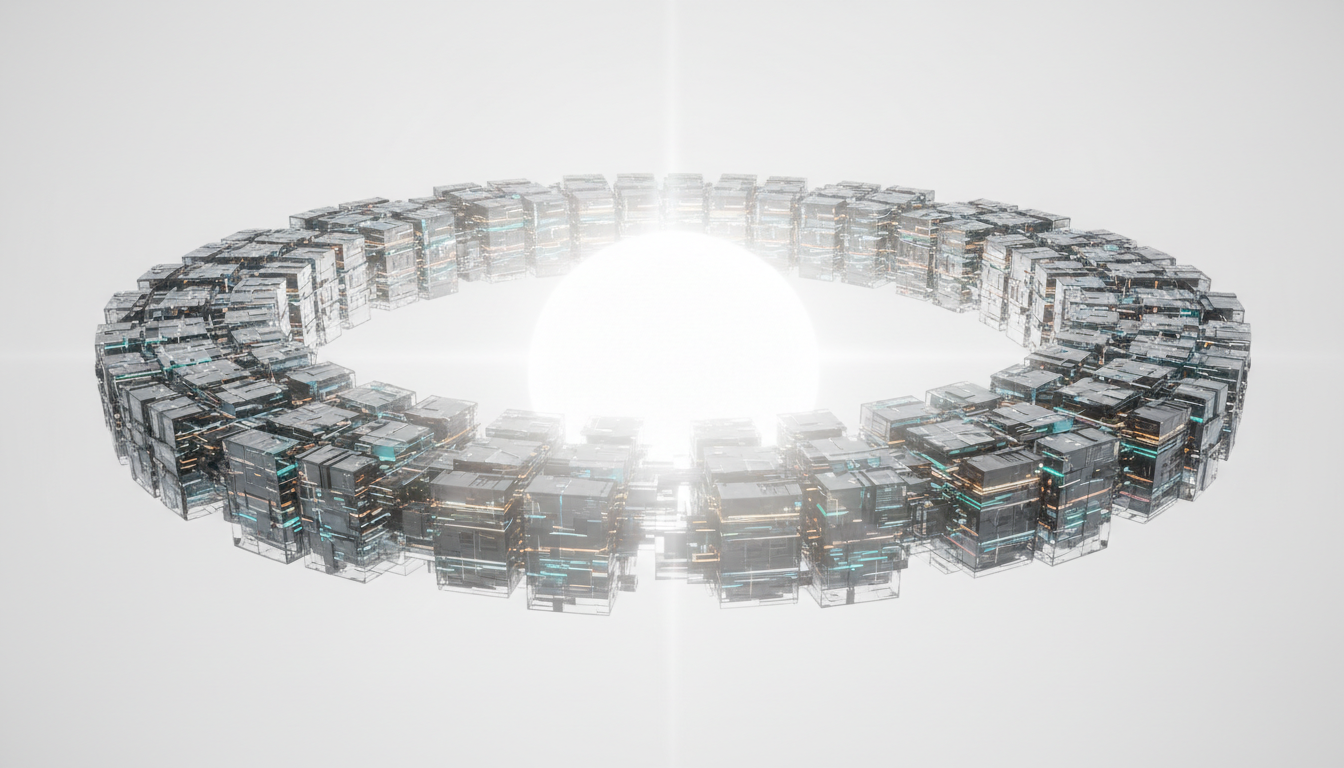
The Orbital Ring

The first tier is a constellation of archive nodes distributed across orbital planes so that no single conjunction, collision or solar event can take the archive as a whole.

A ring is a useful mental model but a poor literal plan. In practice the architecture is a set of inclined planes with deliberately staggered separation, each node carrying an independent copy and an independent power budget. Latency to the ground stays low enough for verification and retrieval, while physical separation becomes structural rather than nominal.

The orbital tier is the only layer that can be commissioned within a generation. It is therefore the layer that must carry the most weight early, and the layer held to the strictest standards of media endurance.

Multiple planes

so no single conjunction threatens the set

Independent power

each node carries its own generation and storage

Verifiable

integrity published continuously to ground stations

11
Tier II

Rugged Planetary Installations

The second tier moves archives onto other bodies — installations engineered for vacuum, thermal cycling and decades without a technician.

The design language changes at this tier. Terrestrial data centers are built around serviceability: humans walk in, replace components, and take the environment for granted. A rugged installation is built around the opposite assumption. Component access is rare, thermal management is passive wherever possible, and every subsystem is specified by how long it can operate unattended.

These installations are also the tier where archives stop being purely digital. Physical reference material, format documentation and instruction sets travel with the data, because the ability to read something is part of preserving it.

At a glance

Environment
Vacuum or thin atmosphere, extreme thermal cycling, no servicing visits.
Service model
Intermittent robotic maintenance with years between interventions.
Companion media
Reader specifications and format documentation archived alongside the data.
12
Tier III

Toward the Stars

The third tier is the one the company will not live to see commissioned: replicas designed to leave the solar system and outlast the language they were written in.

Interstellar placement is not an escape plan; it is the logical conclusion of a preservation argument. If the objective is that a record should survive the evolution of its host star, then at some point the record must either be moved or accept its fate. Everything in the third tier exists to make the first option a decision rather than a hope.

Work at this horizon is necessarily speculative in method and rigorous in constraint. Mass budgets, deceleration, thermal survival, and the problem of a receiver who has never heard of us — these are engineering questions before they are poetry.

An archive that can only survive on Earth is not an archive. It is an extremely well-organised risk.
Mutant Corporation — Archive Doctrine
13
Horizon

The 100 to 1,000 Year Horizon

Operating across a proposed technological horizon of one hundred to one thousand years, the company aims to build a truly resilient interstellar archive.

A hundred years is the range in which institutions can still be held accountable. A thousand years is the range in which they cannot. Planning for both means writing two kinds of documents: contracts, schedules and standards for the near horizon, and durable design rationale for the far one.

This horizon also dictates a specific relationship with technology. Systems built for a millennium cannot depend on any single vendor, protocol or power standard. They depend instead on physical principles, redundancy and legibility — the three things that have never needed an update.

At a glance

100 years
Orbital tier operational, integrity continuously attested.
300 years
Multi-body replication with autonomous custodianship.
1,000 years
Interstellar replicas and inherited governance.
14
Durability

What Survives a Millennium

Very little of what we build survives a century. The shortlist of what reaches a millennium is defined less by strength than by simplicity.

Stone survives. Inscriptions survive. Structures that do not require energy, maintenance, or a supply chain survive. Nothing electronic has yet crossed a thousand years, which means the archival industry has no empirical proof of concept for its central claim — only a set of physical arguments about degradation rates and the cost of active correction.

Those arguments are good ones, but they impose humility. A millennium archive is not a device. It is a protocol for continuous renewal, in which the media are replaced repeatedly and only the data and the instructions for reading it are truly preserved.

We do not preserve objects. We preserve instructions for reconstructing meaning.
Mutant Corporation — Archive Doctrine
Part IV — Engineering the Void
15
Media

Radiation-Hardened Storage

Deep space is an ionizing environment. Next-generation archival media must withstand cosmic rays and solar radiation without silent corruption.

Terrestrial storage assumes a magnetosphere and an atmosphere that together remove most high-energy particles before they arrive. Outside that shield, single-event upsets become routine and cumulative displacement damage becomes a design parameter. The archival media developed for orbital and deeper use combine hardened physical substrates with coding schemes that detect corruption as a matter of course.

The engineering target is not immunity — no material is immune — but predictable failure. A medium that degrades in a documented way can be corrected. A medium that fails opaquely cannot, no matter how sophisticated the reading hardware.

At a glance

Substrate
Wide-bandgap materials chosen for displacement tolerance rather than speed.
Coding
Heavy forward error correction with continuous integrity proofs.
Predictability
Documented degradation curves so correction is planned, not reactive.
16
Autonomy

Autonomous Maintenance and AI Custodians

A century-long archive cannot depend on a maintenance schedule. It must be able to diagnose, repair and migrate itself.

Autonomous custodianship is the difference between a vault and a backup. The custodian continuously verifies the archive, identifies degraded blocks, reconstitutes them from parity and replicas, and rebalances storage as media age. It also maintains its own model of the archive's contents so that migration decisions preserve meaning, not just bytes.

The hard constraint is trust. An autonomous system that can rewrite the archive can also erase it. Custodians are therefore built with narrow authority, published decision logs, and a strict prohibition on modifying content — they may move data, never edit it.

At a glance

Verify
Continuous integrity attestation across every replica.
Repair
Reconstruction from parity and remote copies without human action.
Constrain
Custodians may relocate data, never alter it. Every action is logged.
17
Redundancy

Decentralized Redundancy

Spreading archives across multiple celestial bodies ensures no single cosmic event — solar flare, impact, or stellar change — can compromise the whole of human history.

Redundancy in one location is depth. Redundancy across bodies is breadth. Only breadth survives events that are correlated by location, which is precisely the class of events capable of destroying a planetary archive.

The architecture maintains a quorum model: content is considered retained only while a defined number of geographically independent replicas remain verifiable. When a replica falls out of quorum, restoration is prioritized before any new content is accepted.

Depth protects against failure. Breadth protects against catastrophe.
Mutant Corporation — Archive Doctrine
18
Hazard

Solar Weather

The star that makes the archive possible is also its most persistent natural threat.

Coronal mass ejections and solar particle events deliver radiation that can degrade a satellite's electronics in hours. For an orbital archive, the mitigation is layered: hardened media, dormant cold storage during high-activity windows, and predictive scheduling that shifts verification workloads away from the leading edge of a storm.

Solar weather is also an argument for distance. A node beyond the inner system experiences the same star at a safer distance, which is one of several reasons the second and third tiers exist.

Hours

typical warning before a significant particle event

Layered

hardening, dormancy windows and workload shifting

Distance

the only mitigation that never needs maintenance

19
Hazard

Impact Events

Rare, cumulative, and entirely capable of erasing a ground-based archive: impact risk is a scheduling problem disguised as a catastrophe.

The probability of a civilization-ending impact in any given century is small. The probability across the operational lifetime of a millennium archive is not. Treating the tail risk as negligible is precisely the error a preservation project exists to avoid.

Orbital and off-world placement reduces exposure but does not remove it. Nodes are separated in inclination and altitude, debris tracking informs maneuvering budgets, and the quorum model assumes that individual nodes will be lost.

A one-in-a-thousand risk taken across a thousand years is a certainty.
Mutant Corporation — Archive Doctrine
20
Hazard

Stellar Evolution and the Long Night

Every star ages. The longest-horizon argument for interstellar replication is not adventure — it is the eventual unsuitability of our own Sun.

On timescales far beyond human institutions, solar luminosity rises, the habitable zone migrates, and the inner system becomes progressively less forgiving. No engineering decision made today changes that trajectory; the only decision available is whether the record moves before it must.

The third tier exists for that question. It is deliberately over-engineered for the present, because the alternative is discovering, at the worst possible moment, that the archive was designed for exactly one epoch of one star.

At a glance

Near term
No action required. Solar behavior is within archived tolerances.
Long term
Luminosity increase drives the habitable zone outward over geological time.
The choice
Replicate beyond the system, or accept that the archive has an expiry date.
21
Systems

Energy, Heat, and Keeping the Lights On

In vacuum there is no convection. Every watt an archive consumes must be radiated away, and every watt must first be collected.

Thermal management is the least glamorous and most binding constraint in orbital storage. Waste heat can only leave by radiation, and radiator area scales with the fourth power of temperature — a fact that shapes enclosure design, duty cycles and even the choice of media. Energy is a similar story: solar flux falls with the square of distance, so deeper archives must either accept lower duty cycles or carry their own generation.

The design response is to treat power and heat as first-class archive properties. Verification schedules, migration windows and retrieval availability are all derived from the thermal and electrical budget rather than assumed.

At a glance

Radiative only
No air means no convection; radiator area is a hard design limit.
Duty cycles
Verification and migration scheduled around the energy budget.
Distance
Solar flux falls with the square of the distance from the Sun.
Part V — Vaults Beyond the Cradle
22
Site

Low Earth Orbit

The operational frontier: continuous downlink, modest radiation exposure, and a launch cadence that makes iteration possible within a single career.

Low orbit is where archival media meet the space environment for the first time at meaningful scale. It is close enough to be serviced and monitored, and harsh enough to expose design weaknesses that ground testing cannot reproduce. Almost every assumption in the stack gets tested here.

It is also the tier that keeps the archive useful. An archive nobody can reach is a monument. An archive with a verification path measured in minutes is infrastructure.

Minutes

round-trip verification path to ground

Servicable

the only tier where physical recovery remains routine

Iterative

media and custodian upgrades on a single-career cadence

23
Site

Lagrange Points

Gravitational equilibrium offers station-keeping economy and geometry that keeps a node permanently shielded or permanently sunward, depending on the point.

Not every archive node needs to be busy. Some are placed where the physics is quiet: a stable orbit that requires almost no station-keeping, with a thermal environment that varies slowly and a communications geometry that can be predicted decades ahead.

These sites are the natural home for the deepest cold copies — the replicas that are verified on a slow schedule and otherwise left alone. Their value is not throughput. It is the near-elimination of the reasons archives usually fail.

At a glance

Station-keeping
Equilibrium orbits reduce propellant demand to nearly nothing.
Thermal stability
Slowly varying environment favors long-lived media.
Deep cold copies
Slow-schedule verification for the least-changed replicas.
24
Site

The Lunar Vault

A body without atmosphere, weather or geology in motion — the most stable real estate within reach of a launch pad.

The Moon offers something no orbit can: ground. A vault beneath the surface is shielded from radiation by metres of regolith, thermally buffered by the mass around it, and free of the orbital debris problem entirely. It is also reachable on a cadence measured in days rather than years.

The lunar installation is the proving ground for the rugged tier. Whatever is learned about long-duration autonomy there is what makes a Martian replica credible.

On the Moon, the archive inherits the oldest protection there is: distance from weather.
Mutant Corporation — Archive Doctrine
25
Site

The Martian Replica

The first true second-planet copy: different gravity, different atmosphere, different failure modes, and a light-time delay that forbids real-time control.

Mars is where the archive stops being an Earth program with orbital extensions. Signals take between roughly four and twenty-four minutes each way depending on orbital geometry, which means every operation must be planned, validated and delegated rather than driven. Custodianship stops being a convenience and becomes a requirement.

The Martian tier also delivers the property the whole architecture is built for: a copy of human memory that does not share a planet with the original.

At a glance

Light delay
Four to twenty-four minutes each way; no real-time operation is possible.
Delegated authority
Custodians act locally and report asynchronously.
Independent fate
A copy whose survival is not coupled to Earth's.
26
Site

The Asteroid Belt and the Outer Reaches

Beyond Mars the economics change: less sunlight, longer delays, and material resources that make large passive structures plausible.

The belt and outer system are not near-term destinations for archives, but they are the correct long-term geometry. Distributed across many small bodies, an archive gains a redundancy that no single world can offer — and access to bulk material for shielding and structure.

The engineering here is dominated by patience. Duty cycles fall, verification intervals stretch, and the archive becomes something closer to geological than industrial. That is not a defect. It is the point of the third tier.

At the outer reaches, preservation stops being an operation and becomes a condition.
Mutant Corporation — Archive Doctrine
Part VI — The Signal and the Medium
27
Communications

Light, Distance, and Latency

The speed of light is not a network limitation to be optimized away. It is the boundary condition around which the entire archive must be designed.

Terrestrial systems are built on the assumption that a request can wait for a response. At interplanetary distances that assumption collapses. Every design decision — replication protocol, integrity check, even the definition of 'current' — must accommodate the fact that the archive's parts cannot negotiate in real time.

The response is asynchronous by construction: intent-based operations, deterministic execution, and a verification record that allows any node to reconstruct what happened after the fact.

At a glance

Intent, not command
Operations are declared and executed locally, then audited.
Deterministic
The same instruction produces the same result on any node.
Reconstructable
Logs let any replica explain the archive's history without asking.
28
Reliability

Error Correction at Cosmic Scale

Across a link measured in light-minutes, retransmission is expensive and silence is ambiguous. Correction must be local, mathematical, and verifiable without a round trip.

The archive treats error correction as a property of the stored object rather than the transport. Data is encoded with enough redundancy to be reconstructed from a subset of fragments, so loss is tolerated at the level of individual blocks, nodes, or entire replicas.

Verification follows the same philosophy. Rather than asking a remote node whether it is healthy, the system periodically proves it — a challenge the node can only answer if it still holds the bytes.

Subset recovery

reconstruction from a fraction of stored fragments

Proofs

integrity demonstrated, not asserted

No round trip

verification does not depend on interactive negotiation

29
Formats

File Formats for the Ages

A format that requires a specific vendor's software in a specific year is not preservation. It is a scheduled loss with a delayed timestamp.

The archive specifies the simplest formats that can carry the content and documents them completely: plain text, uncompressed raster, open container specifications, and full schema descriptions stored beside the data. Anything more exotic travels with its own reader.

The governing question is not what is convenient now, but what a competent engineer with no context could reconstruct. That question tends to produce specifications that are shorter, not longer.

The best archival format is the one a stranger can decode without asking us anything.
Mutant Corporation — Archive Doctrine
30
Integrity

Bit Rot and the Machine-Readable Past

Silent corruption is the quietest failure mode in computing: the file is present, the checksum was never re-run, and the content is already gone.

Bit rot is not a metaphor. Magnetic domains relax, optical dyes fade, flash cells leak charge. Every medium degrades, and the degradation is invisible until something reads it and compares. The only defence is continuous verification against a recorded expectation.

The archive therefore keeps hashes as first-class content, not metadata. Each object carries a verifiable identity, and every replica is checked on a schedule derived from its media's measured failure characteristics rather than from convenience.

At a glance

Recorded expectation
Content hashes stored with the object itself.
Scheduled verification
Cadence derived from measured media degradation rates.
Repair before loss
Failing blocks reconstituted from parity while replicas still exist.
31
Legibility

The Long Reader

Every archive is written for a reader who does not yet exist. The design question is how much context that reader will need.

A future reader may lack our hardware, our protocols, our languages, and our assumptions about what a file is. The archive answers with layered documentation: physical encoding described from first principles, format specifications in multiple languages, and curated context explaining why the content mattered to the people who deposited it.

This is the least technical and most consequential part of the program. Data without context is noise, and noise is indistinguishable from loss.

Preservation ends at the moment the record can no longer be understood.
Mutant Corporation — Archive Doctrine
Part VII — Who Owns Memory
32
Governance

Sovereignty, Jurisdiction, and Treaty

An archive beyond the atmosphere leaves the legal framework that terrestrial storage depends on, and that gap must be designed for rather than discovered.

Orbital assets sit within a treaty regime that is decades old and silent on archival custodianship. Data in space raises questions terrestrial law answers poorly: whose jurisdiction applies to a vault in transit, what happens when the depositor ceases to exist, and how a retrieval right is enforced across four light-minutes.

The company's approach is contractual layering — private agreements bound to a published governance framework, designed to remain legible if the underlying treaties change. Nothing here is settled. What can be settled is transparency about which questions remain open.

At a glance

Deposit terms
Retrieval rights survive the depositor and travel with the archive.
Custodial neutrality
The archive may not be altered by any operator, including Mutant.
Published framework
Governance documented publicly and versioned like software.
33
Stewardship

Custodianship and Governance

Institutions fail faster than archives. The preservation program is therefore built to survive its own founders, its own funders and its own success.

Governance is structured so that no single party — including the company — can unilaterally delete, decrypt or reinterpret the archive. Authority is split between technical custody, content stewardship and public accountability, and each has a duty to report.

Succession planning is treated as an engineering artifact: charters, key ceremonies, rotation schedules and documented rationale, all archived inside the system they govern. A custodian that cannot explain itself to a successor is a single point of failure.

Ownership ends. Custodianship is the only relationship that can outlast a corporation.
Mutant Corporation — Archive Doctrine
34
Curation

Curation and the Ethics of What We Keep

Selection is unavoidable, and every selection is a judgment about what future generations deserve to inherit.

A complete archive of everything is neither technically feasible nor intellectually honest. Curation is therefore disclosed rather than hidden: criteria are published, decisions are documented, and communities retain the right to deposit their own record in their own terms.

The ethical posture is humility. The archive does not claim to know which of today's works will matter in five centuries. It claims only that the choice should be transparent, contestable and reversible where possible.

At a glance

Disclosed criteria
Selection rules published and versioned alongside the content.
Community deposit
Groups may archive their own record on their own terms.
Contestable
Inclusion and exclusion decisions can be challenged and revisited.
35
Pledge

Securing Tomorrow, Today

The work begins now precisely because it will not finish soon. Every year of delay is a year of memory that exists only on one world.

Mutant Corporation is building an interstellar archive in increments: media first, then orbit, then other worlds, then the long transit outward. Each increment is verifiable, useful on its own, and load-bearing for the next. That is what separates a multi-generational program from a manifesto.

The promise is deliberately modest. We cannot guarantee that everything will be preserved. We can guarantee that the attempt will be engineered honestly, documented publicly, and designed to continue after everyone who started it has gone.

The archive is not a monument to the present. It is a message to a future we will never meet.
Mutant Corporation — Archive Doctrine

Securing tomorrow, today

One world is not a backup.

The archive is built in increments that can each be verified on their own, and each of them begins with the same decision: to treat humanity's record as something worth carrying past the planet it was written on.

The stars are waiting.
And we are making sure they remember us.

Join the generation that decided human memory would outlast the planet it was born on.